Yes, for most commercial and industrial sites. An EICR and a thermal imaging survey check different things, in different conditions, so they work best together. Thermal imaging does not replace an EICR, and an EICR does not replace thermal imaging. Used side by side, they give you a much fuller picture of your electrical risk.
Who this is for: facilities managers, building and estates managers, and owners of commercial and industrial premises in the UK.
An Electrical Installation Condition Report (EICR) is a formal inspection and test of your fixed wiring: the circuits, distribution boards, protective devices and earthing. The IET explains that its purpose is to judge whether the installation is suitable for continued use. In the IET's own words, "It is not a fault-finding exercise."
That is by design, not a weakness. Three things shape what it can and can't see.
Many EICR tests are carried out with the supply safely isolated. Continuity of protective conductors, insulation resistance and polarity are typical examples. With the power off, a connection that only overheats under load has no chance to show itself.
On larger sites, the engineer and the client may agree a sample of circuits for the report, rather than testing every one. Circuits outside the sample are not tested on that visit.
The IET model EICR form states that cables hidden in trunking and conduit, under floors, in roof spaces, within the fabric of the building or underground are not inspected unless this is specifically agreed. Operational limitations, such as no access to part of the installation, are recorded in Section D of the report.
For how often you need an EICR, see our guide to fixed wire testing intervals, or find out more about our EICR service.
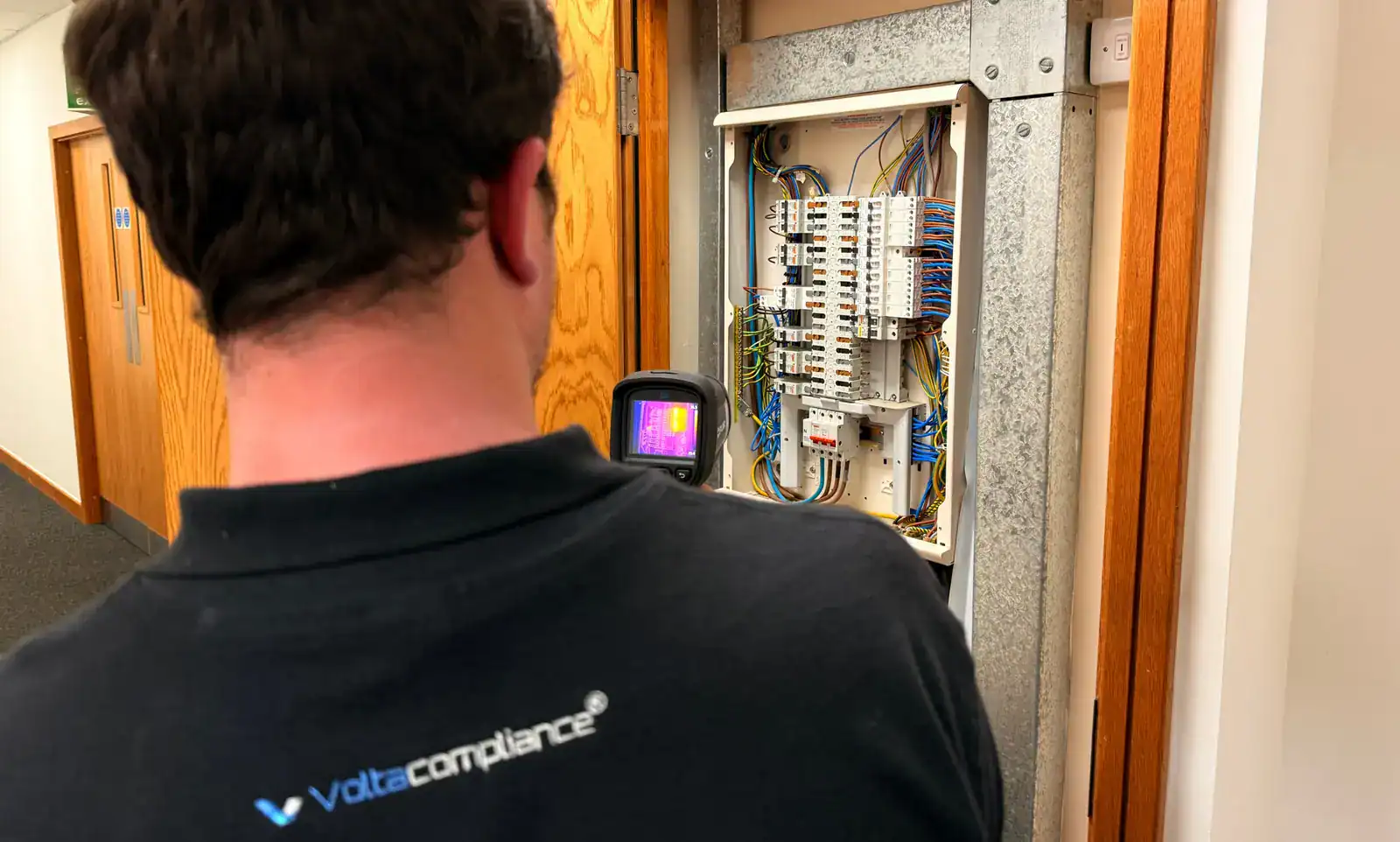
A thermal imaging survey (also called thermography) is a non-contact check. A trained engineer uses a thermal camera to build a heat map of your electrical equipment while it is running. Hot spots stand out. Our article on how electrical thermal imaging works covers the basics.
Because the survey happens live and under load, it picks up faults that only show up as heat. Aviva's guidance on thermographic surveys lists loose connections, poor terminations, overloaded circuits and under-rated equipment among the causes of hot spots. Failing components can show up in the same way.
Loose terminals are a good example. When a loose terminal is carrying load, arcing can happen inside the threads, causing damage a visual check can't see. On a quiet day, with little current flowing, the same terminal may give no sign of trouble at all.
Government guidance on low voltage inspection and testing, written for the defence estate, makes a similar point. It warns that meter tails and junction box terminations "can come loose and create potential fire risks". It also lists thermographic surveys among the points to agree before an inspection starts.
The two checks cover each other's blind spots. A thermal camera can't measure insulation resistance or prove that protective conductors are continuous. An EICR can't show you which connection is running hot on a busy Tuesday afternoon.
Thermal imaging is not named as a legal requirement. But the law does require you to maintain your electrical systems.
Regulation 4(2) of the Electricity at Work Regulations 1989 says that, as may be necessary to prevent danger, all systems shall be "maintained so as to prevent, so far as is reasonably practicable, such danger."
The HSE points out that the Regulations leave the detail open. They don't say which checks to carry out, who should do them or at what intervals. That decision sits with you, based on the risks at your site.
Thermal imaging is one recognised way to show you are maintaining your electrical systems. The IET says thermal imaging checks can form part of an inspection regime, as long as safe methods of working are followed and the equipment being checked is suitable.
There is no legal interval. A useful benchmark comes from Aviva, the UK insurer, in its loss prevention standard on thermographic surveys.
Aviva recommends surveys for all sites, covering all equipment, machinery and plant, "at least annually". If repeated surveys show no issues, it says the gap can be stretched, for example to every 18 months and later to every two years. If results are not improving, surveys should happen more often.
In practice, start with a yearly survey, keep every report and let the results set the pace. Our article on the role of thermal imaging in preventative electrical maintenance shows how surveys fit into a wider maintenance plan.
Some do. Aviva recommends thermographic surveys for all sites, and some insurers ask about them, so it's worth checking your own policy or asking your broker.
Aviva is also clear that thermography sits alongside the inspection and testing of fixed wiring, not in place of it. A clean thermal survey is not a substitute for an up-to-date EICR.
Aviva advises that equipment should be running as close to full load as possible during the survey. It notes there is usually little value in scanning equipment cold or at half load, because hot spots may not appear. Book the survey for a normal working day at a busy time, not a quiet weekend.
Aviva says engineers should be fully trained and hold a recognised certification to at least Level 2, under a scheme such as ISO 18436-7. Ask to see certificates before you book.
A survey only reduces risk once the hot spots are fixed. Prioritise the most serious findings, book the remedial work and have repaired items rescanned to confirm the fix worked. Our guide to what the colours in a thermal imaging report mean helps you read the results.
Store each thermal report alongside your EICR. Comparing the same equipment, surveyed in a consistent way, shows whether a connection is getting worse over time. That trend also tells you whether you can safely stretch the interval or need to shorten it.
Check Section D of your EICR for anything not inspected or tested. Then ask whether a thermal survey could cover any of that equipment, where it is suitable for scanning.
| EICR | Thermal imaging survey | |
|---|---|---|
| What it checks | The condition of your fixed wiring and whether it is suitable for continued use | Heat patterns in electrical equipment while it runs |
| Power on or off | Much of the testing is done with the supply safely isolated | On, ideally at as high a load as possible |
| What it finds | Damage, deterioration, defects and non-compliances, coded by urgency | Loose connections, poor terminations, overloaded circuits, under-rated equipment and failing components |
| How often | At the interval recommended on your last report, based on the type and use of the premises | Aviva recommends at least annually, extended if results stay clean |
| What you get at the end | A report stating whether the installation is satisfactory or unsatisfactory, with coded observations | A report with thermal images of any hot spots, the condition of each item and the action needed |
Usually not. The survey works best with equipment running normally, so it fits around a working day. Your engineer will agree safe access to boards and panels with you before starting.
Yes. A survey soon after a new installation goes live can catch poor terminations early, ideally while the work is still under warranty.
It's a useful extra for day-to-day checks. But it isn't the same as a formal survey and report from a certified thermographer. Our guide to DIY vs professional thermal imaging explains the difference.
Not really. What matters is that both happen and each engineer can see the other's findings. That way any remedial work can be planned together.
At Volta Compliance, our engineers are registered with NICEIC and the Electrical Safety Register. Most of our work is done in normal hours, which suits thermal imaging because your equipment is running under its usual load. When required, we test out of hours. You can see your certificates and reports in our online portal at easycompli.com. We work across Yorkshire and Lancashire.

