Call
0113 436 0402

Request A Quote
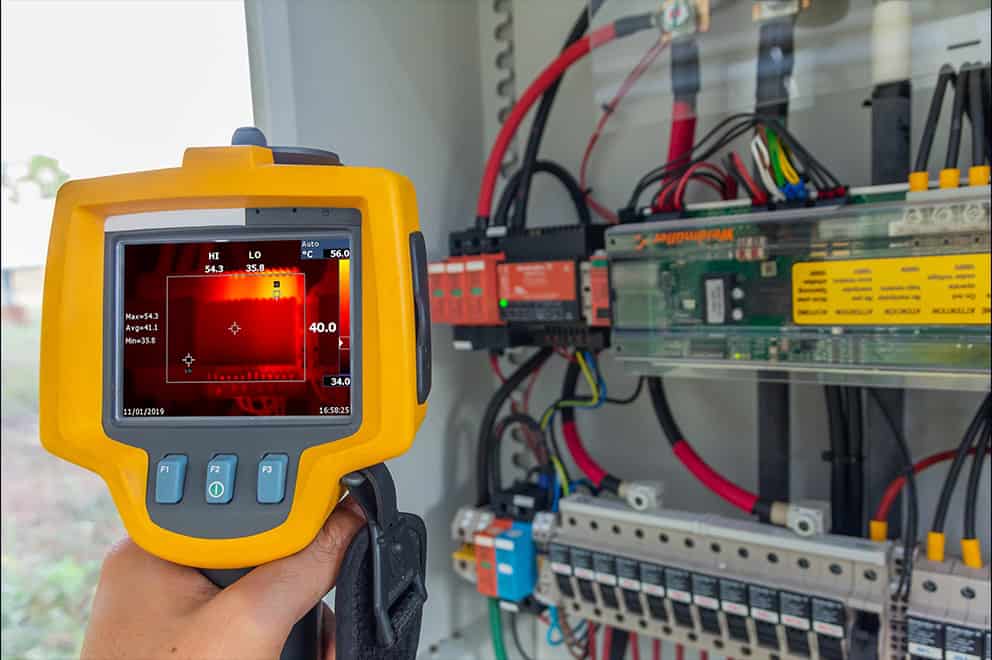
It’s often said that prevention is better than the cure – and that’s certainly the case when it comes to electrical safety. It’s no secret that preventative maintenance is essential to keeping your premises and people safe and saving you money.
But while traditional inspections cover visual checks, circuit testing and scheduled servicing, there is one technique that sets the gold standard for spotting issues early – thermal imaging.
Sometimes called infrared thermography, it translates invisible radiation into a colour map of surface temperatures. By revealing hot and cold spots on live electrical equipment, this gives maintenance teams a clear early warning system for hidden faults.
In high-demand environments, such as warehouses, factories and data centres, the difference between catching loose connections early and dealing with a full-scale outage can be measured in hours of downtime and thousands of pounds. Here’s how it works, and why it’s a vital part of routine electrical maintenance.
Whenever current flows through a conductor, heat is produced. In a healthy circuit, the heat stays within a predictable range. However, if resistance rises, through a corroded terminal, overloaded breaker or weakened insulation, temperature climbs.
Not only is that extra heat wasted energy – it’s also a warning sign of potential danger. If left ignored, it could lead to the risk of burnt contacts, insulation failure, arcing or even fire.
The warning signs are also easy to miss, as conventional inspections rarely detect these early-stage temperature rises. Components that may pass a visual check and seem in good order could be running significantly hotter than they’re supposed to.
The good news is that a thermal camera can pick up these anomalies instantly, guiding engineers to the exact point of concern.
A proactive maintenance schedule already includes periodic Electrical Installation Condition Reports (EICR), PAT testing and routine visual inspections. Thermal imaging complements these measures by adding a live, non-intrusive check that can be carried out without shutting down equipment.
The first step is to capture reference images of key distribution boards, switchgear, control panels and high-load machinery under normal operating conditions. This baseline provides a benchmark for future comparisons.
Scheduled thermal surveys – quarterly for critical systems, annually for lower-risk areas – highlight deviations from the baseline. Even a 10-degree increase at a single connection can signal a developing fault.
Because thermal imaging pinpoints the exact location of overheating, remedial work is faster and more focused. Engineers can tighten a loose connection, balance phases or replace a failing breaker without unnecessary downtime.
Storing thermal images alongside EICR findings builds a comprehensive maintenance record. In the event of an audit or insurance claim, these images prove that your business took a proactive approach to managing risks.
Identifying these issues early not only helps prevent breakdowns but also improves energy efficiency, since excess heat is essentially lost power.
While the primary purpose of thermal imaging is risk reduction, businesses quickly see wider advantages. Energy savings accumulate as hot spots are eliminated. Planned interventions, rather than emergency call-outs, reduce overtime costs.
Perhaps most importantly, regular thermal surveys foster a culture of vigilance that keeps safety front of mind for everyone on site.
Thermal imaging is most powerful when it forms part of a planned preventative maintenance (PPM) cycle:
A structured approach turns thermography from a one-off exercise into a living tool that continuously guards performance and compliance.
Without thermal imaging, faults in electrical systems often go unnoticed until they trigger an alarm – or worse, a system failure. By the time a component fails, the damage is already done, often resulting in downtime, expensive callouts and reputational risk.
Thermal imaging helps maintenance teams stay ahead of the curve by identifying issues like:
These often produce increased resistance, which generates heat. Thermography highlights hotspots before they develop into arc faults or equipment failure.
Excess load will show up as elevated temperature in conductors and breakers, helping you redistribute loads or upgrade capacity in time.
In three-phase systems, unequal loading can lead to overheating on one leg of the system, putting strain on equipment and reducing efficiency.
Components nearing the end of their life may show heat build-up long before they physically fail.
Using thermal imaging to catch these issues early is not just smart – it’s cost-effective. A brief scan with a thermal camera can reveal dozens of potential hazards in a typical industrial switchboard or panel, all without disconnecting the power.
Insurers increasingly view thermography as evidence of risk management, often rewarding policy-holders with reduced premiums. Likewise, the HSE has cited thermal images as acceptable proof that duty-holders are “taking reasonably practical steps” under the Electricity at Work Regulations 1989.
By archiving data thermograms alongside EICR certificates, you demonstrate a robust, auditable trail of preventative action. Should an incident occur, you can show inspectors exactly how hot spots were identified and rectified, greatly reducing the chance of enforcement action or reputational damage.
Thermal imaging converts invisible temperature anomalies into actionable data, giving maintenance teams a head start on faults that would otherwise remain hidden until failure. When integrated into a wider preventative programme – covering inspections, testing and targeted repairs – it delivers measurable gains in safety, uptime and energy efficiency.
Volta Compliance specialises in industrial thermography as part of our comprehensive electrical maintenance offering. From one-off surveys to fully managed PPM contracts, we help businesses across Yorkshire see problems before they burn through budgets.
Ready to add thermal imaging to your maintenance toolkit? Call our friendly team on 0113 436 0402 or email info@voltacompliance.com for a no-obligation quote, and keep your electrics running cool, safe and cost-effective – no matter how hot the workload gets.
