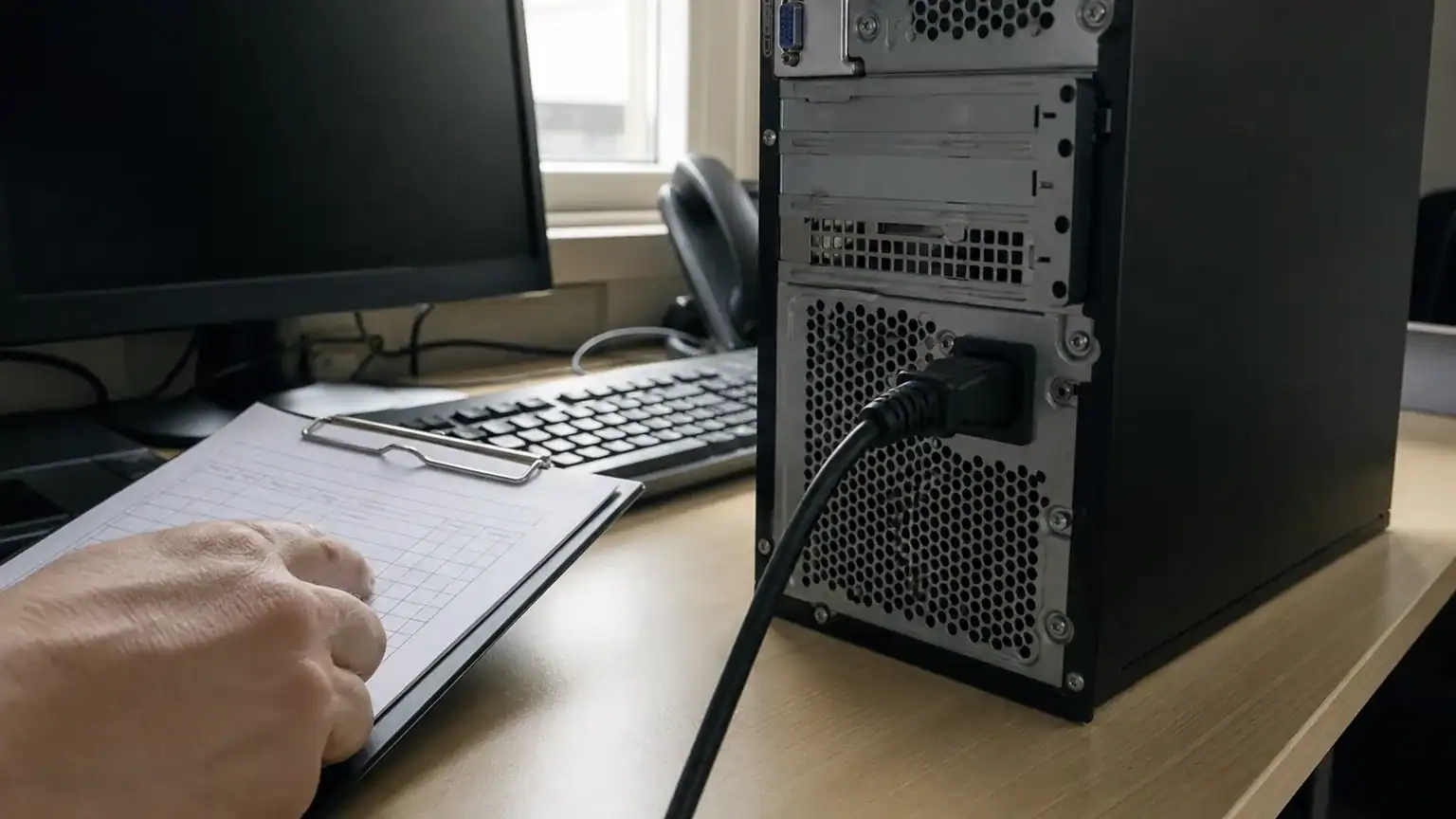
There is no single fixed interval for an office. How often you check portable equipment depends on what it is, how it is used and where, and offices sit at the lower-risk end of that scale. The Health and Safety Executive (HSE) guidance suggests a formal look over rarely moved office IT, such as desktop PCs and photocopiers, every 2 to 4 years, while the National Inspection Council for Electrical Installation Contracting (NICEIC) places low-risk kit in a two to five year bracket. Whatever interval you start with, adjust it as experience shows what your equipment actually needs.
If you look after electrical safety in a UK office but you are not an electrician, this guide is for you. It explains what a PAT test involves, how testing intervals depend on equipment type, use and environment, how new appliances are treated, who can do the work, and what records and labels do for you.
A PAT test (portable appliance test) starts with a look at the appliance and finishes with electrical tests. Electrical Safety First describes the first step simply: "A competent person checks the appliance, plug, and cable for visible damage." The HSE adds that the inspection done alongside testing should usually include checking "the correct polarity of supply cables".
NICEIC says a registered electrician will "use specialist test equipment to perform a full set of tests on each appliance", including:
Both steps matter. The HSE explains that some faults, such as a broken earth wire inside a flexible cable, deteriorating insulation, or contamination of internal and external surfaces, "cannot be detected by visual examination alone".
The electrical certification body NICEIC says how often you test should come from a thorough risk assessment, and it puts low-risk appliances such as desktop computers or vacuum cleaners at "say, once every two to five years". By contrast, NICEIC says high-risk equipment like factory machinery should be tested much more often, quarterly or biannually.
The Health and Safety Executive (HSE) gives more detailed suggested intervals. For office IT that is rarely moved, such as desktop computers, photocopiers and fax machines, the HSE suggests a formal visual inspection every 2 to 4 years. A combined inspection and test is not needed if the item is double insulated (known as Class II), and otherwise can be up to 5 years apart. The HSE says Class II equipment that is moved occasionally but not hand-held, such as fans and table lamps, gets a visual inspection every 2 to 4 years and no test.
For other common equipment, the HSE's suggested intervals are:
| Equipment (HSE examples) | User checks | Formal visual inspection | Combined inspection and test |
|---|---|---|---|
| Hand-held Class II (double insulated): some floor cleaners, some kitchen equipment | Yes | Yes, 6 months to 1 year | No |
| Earthed (Class I): electric kettles, some floor cleaners | Yes | Yes, 6 months to 1 year | Yes |
| Battery operated (less than 40 V) | No | No | No |
| Extra low voltage, telephone equipment, low-voltage desk lights | No | No | No |
Staff can do much of the day-to-day work. The HSE says "a relatively brief user check", based on simple training and perhaps a short checklist, "can be a very useful part of any electrical maintenance regime".
Get a free quote for your compliance testing
The HSE says the period between formal visual inspections "can vary considerably, depending on the type of equipment, the conditions of use and the environment." Its own comparison makes the point: equipment on a construction site or in a heavy steel fabrication workshop "will need much more frequent inspection than equipment such as computers in an office."
The HSE frames this as a question of risk. How often you inspect, and whether you test at all, depends on what the equipment is, how it is used, how often it is used and where. Maintenance needs to happen more often where the risk is high and less often "where the risk is lower, eg in offices."
So even inside one office, a single interval for everything rarely makes sense. A desktop computer that never leaves the desk and a kettle that is filled, carried and plugged in several times a day sit at opposite ends of the HSE's suggested ranges, as the table earlier in this post shows.
Whatever starting point you choose, the HSE says "the period between inspections should be reviewed in the light of experience." If an item keeps turning up damaged, look at it more often. If inspections keep finding nothing, you may be able to space them out.
The HSE gives a worked example. An office vacuum cleaner was heavily used, and its cable had been repaired by an electrician 6 months earlier after being pulled out of the cable grip. The manager decided it "should have a visual inspection every 6 months", and staff were encouraged to check the plug and cable for damage before plugging it in.
When something does fail a check, the HSE says faulty equipment "should be taken out of service and not used again until properly repaired."
The Health and Safety Executive (HSE) says new equipment "should be supplied in a safe condition and not require a formal portable appliance inspection or test." The HSE does still recommend "a simple visual check" to verify the item is not damaged.
The HSE also says there is "no legal requirement to label equipment that has been inspected or tested", nor to keep records. It adds that a record or label can still be "a useful management tool" for reviewing your maintenance scheme and showing that one exists.
In many low-risk environments such as offices, the HSE says "a sensible (competent) member of staff can undertake visual inspections if they have enough knowledge and training."
Responsibility for that competence sits with you as the employer. The HSE's guidance on maintaining portable electrical equipment says people testing portable equipment "should be appropriately trained", and that it is "the employer's duty to make sure that they are competent for the work they are to carry out." That same HSE guidance adds that testing "can often be carried out by a competent employee."
The HSE's guidance document HSG107, Maintaining portable electrical equipment, sets out two levels of competence for the person doing the testing:
The Health and Safety Executive's main guidance on portable equipment, HSG107, says at paragraph 52 that there is "no legal requirement to keep maintenance logs for portable electrical" equipment.
Keeping records is still worthwhile, and two things make it straightforward:
At Volta Compliance, clients can see their certificates and reports in our online portal at easycompli.com. Most of our work is done in normal hours, and when required we test out of hours.
Get a free quote for your compliance testing
No. The Electricity at Work Regulations 1989 require electrical equipment that could cause injury to be maintained in a safe condition, but they do not make annual testing a legal requirement. The suggested intervals in HSE's guidance table are not legal requirements either.
Yes. Even if a contractor carries out the maintenance, the dutyholder still has overall responsibility for complying with the law.
Yes, and you should. The period between inspections should be reviewed in the light of experience, and your records can help you judge whether intervals can be altered. For example, a heavily used office vacuum cleaner whose cable had needed repair was moved to a visual inspection every 6 months.
Last reviewed 15 October 2026 by Sam Carr.

