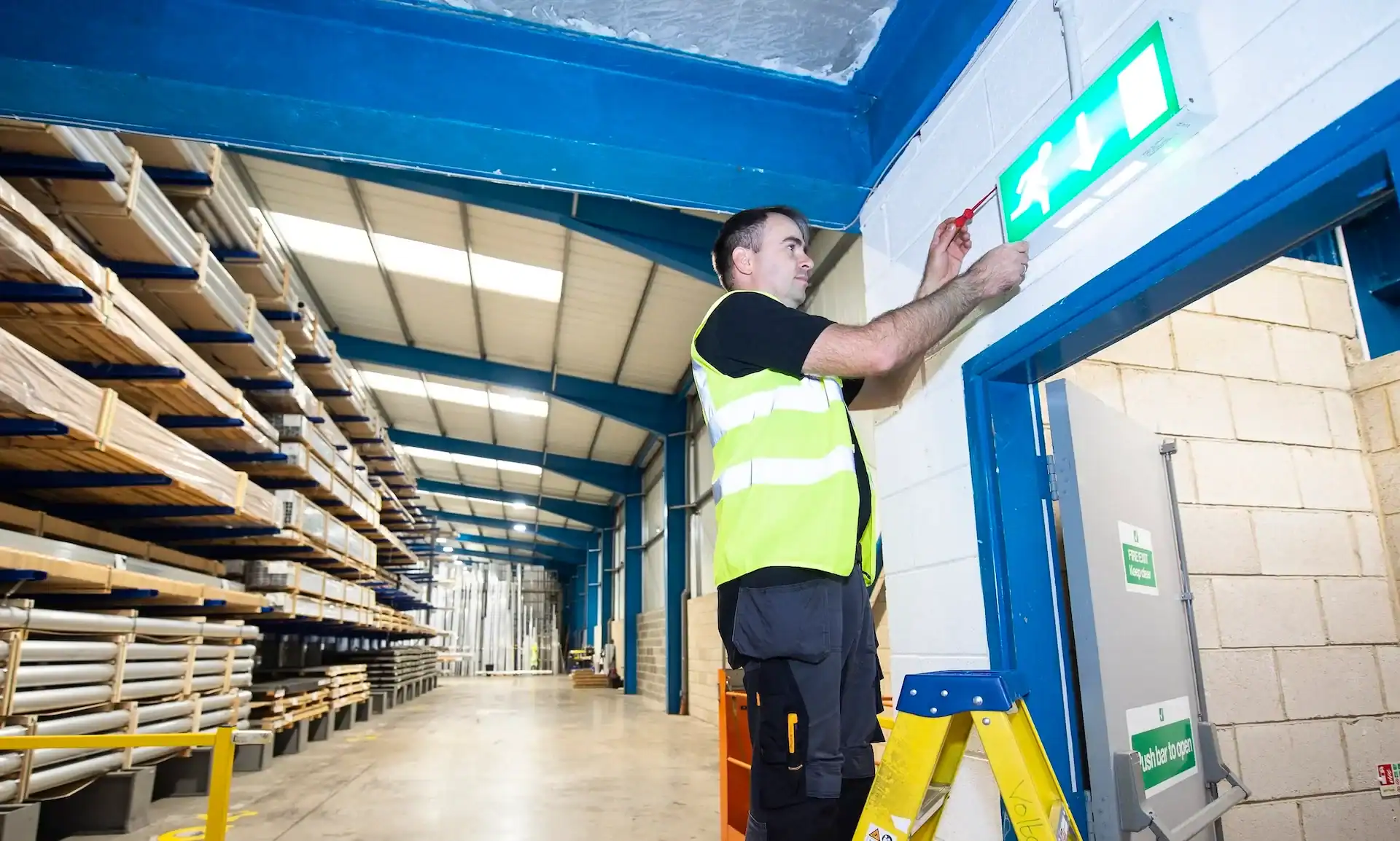
In a UK commercial building, emergency lighting needs a brief functional test at least once each month, plus a full duration test — this is what BS 5266-1 recommends, and the IET confirms the system should be periodically inspected and tested in line with that standard. Once the yearly inspection and test schedule is complete, Clause 6.2 of BS EN 50172 calls for a test certificate to be issued, and results should be kept in your logbook. The duty sits with the owner of the building, the person in control of the premises or the employer, and the testing should be carried out by a competent person — someone suitably trained and qualified by knowledge and practical experience. Emergency lighting is part of a building's fire safety provision and a requirement of The Regulatory Reform (Fire Safety) Order 2005, so these checks are not optional housekeeping.
Emergency lighting is the lighting that takes over when the normal power supply fails. It runs from a battery — either one built into each light fitting or a central battery system — so that a building doesn't go dark the moment the mains goes off.
In practice it comes in two broad flavours, and the guidance from Warwickshire County Council sets out both. Emergency escape lighting is the part of the system that lights the way for people leaving the building, or attempting to leave it. That covers the lights above and along your escape routes — corridors, stairwells, lobbies — as well as illuminated exit signs, and lighting at points where there's something you need to be able to find in the dark, such as fire alarm call points and firefighting equipment. Standby lighting is the other part: lighting provided so that normal activities can carry on substantially unchanged when the mains fails. Standby lighting is about keeping the business running, not about getting people out, so it generally isn't what a fire risk assessment is concerned with.
One piece of jargon worth knowing when you read a test certificate or a quote: a maintained emergency luminaire is one where, as the Warwickshire guidance puts it, "the emergency lighting lamps are on at all times". Your illuminated running-man exit signs are usually maintained fittings — they glow whether or not there's a power cut. Other fittings only strike up when the supply fails, which is why you can walk past them every day and never know whether they still work. That is precisely why routine testing exists.
The British Standard covering these systems frames its scope the same way: it applies to emergency lighting used to assist occupants to leave a building during an emergency, and to help protect occupants in other situations. If a light in your building has a battery behind it and a job to do when the power goes, it falls inside your emergency lighting system and inside your testing regime.
If you run a commercial building in England or Wales, the legal starting point for emergency lighting is the Regulatory Reform (Fire Safety) Order 2005. Emergency lighting is part of the fire safety provision of a building and, as Warwickshire County Council's fire safety guidance puts it, "a requirement of The Regulatory Reform (Fire Safety) Order 2005".
The Order's wording is conditional rather than blanket. It states that "The following requirements must be complied with in respect of premises where necessary" — necessary being judged on things like the features of the premises and the activity carried on there. Where that test is met, escape routes and exits that need illumination must be provided with "emergency lighting of adequate intensity" in case the normal lighting fails.
The Home Office guide for persons with duties under the Order says the same thing in plainer terms: where necessary, if escape routes and exits require artificial illumination, they must also be provided with emergency lighting.
In practice that means two questions for whoever holds the fire safety duty at your premises. First, does this building need emergency lighting — which in most offices, shops and multi-occupied workplaces with internal corridors, stairwells or windowless areas, it will. Second, is the lighting you have actually capable of doing its job when the mains supply drops out. The Order requires intensity that is adequate at the moment of failure, not simply fittings on the wall, and that is why routine testing matters: a battery-backed luminaire that has quietly failed is not compliance, however new it looks.
British Standard BS 5266-1 is the code of practice for emergency lighting in the UK. It does not leave testing frequency to judgement: it sets out a routine of regular tests that the person responsible for the building is expected to keep to.
According to NVC UK's guide to the standard, BS 5266-1 states that emergency lighting should be regularly tested with "a brief functional test at least once each month", plus a full duration test. The monthly check is deliberately short — it confirms each luminaire actually illuminates when the normal supply is cut, and that nothing has failed quietly since you last looked. The full duration test is the longer one, run to prove the batteries still hold their charge for the whole rated period rather than just flickering into life.
| Test | How often | What it proves |
|---|---|---|
| Brief functional test | At least once each month (BS 5266-1) | Every emergency luminaire switches on when the mains supply is interrupted |
| Full duration test | The other test interval set by BS 5266-1 | The batteries sustain the fittings for their full rated duration, not just a few seconds |
The testing does not stop at handover. The IET, answering questions from its emergency lighting webinar, confirms that following the initial design and handover the emergency lighting system should be periodically inspected and tested in line with BS 5266-1. In other words, a system signed off as compliant on day one only stays compliant if the routine tests are actually carried out and recorded.
NICEIC notes that Section 12 of the standard, covering routine inspection and tests, has been updated with new text reiterating the duties around those routine inspections and tests — a useful reminder that if your testing regime was set up some years ago, it is worth checking it against the current edition.
If you are not an electrician, the practical split is straightforward: the monthly function test is a short, repeatable check that a competent person on site can be trained to carry out and log, while the full duration test is the longer annual-cycle job most SMEs hand to their contractor, because a discharged battery leaves the building without emergency cover until it recharges.
A monthly test is deliberately simple. You briefly cut the mains supply to the emergency lighting — usually by turning a key switch, operating a test facility or, in a self-testing system, letting the luminaire do it for you — and then walk the building to confirm that every emergency light and illuminated exit sign actually comes on.
The point is the check itself, not the endurance of the battery. BS EN 50172 covers this in Clause 7.2.3, and the standard's note on the monthly test makes clear that the period of simulated failure should be sufficient for the purpose of the check — in other words, just long enough for someone to walk the route and see that each fitting has illuminated. There is no need to flatten the batteries; that is what the annual full-duration test is for.
What you are looking for is straightforward: does the lamp light, is it bright and not flickering, is the exit sign readable, and is the fitting clean and undamaged? Anything that fails to illuminate gets recorded and repaired. When mains power is restored, the charging indicator on each luminaire should show the battery is recharging, because a drained battery leaves you unprotected until it has recovered.
One practical point the IET raises for anyone specifying or maintaining a system: it is worth checking with the manufacturer of the luminaires how they behave in real conditions, and considering whether your building could face power outages longer than the luminaire was designed for. That is a design and specification question rather than something the monthly walk-round will answer, but it is a sensible conversation to have with your contractor.
Every monthly test should be written up in your emergency lighting logbook with the date, who carried it out, and any faults found and put right. That logbook is the evidence a fire officer or insurer will ask to see.
Once a year, the emergency lights have to run for their full rated duration on battery alone — not the few seconds of the monthly flick test. Your contractor kills the mains supply to the emergency lighting circuits and leaves it off, then checks at the end that every luminaire is still lit and illuminating the escape routes as designed.
The IET's guidance on emergency lighting stresses that the duration used has to be sufficient for the particular site and the luminaires fitted — so the test is matched to what your building's system was designed to deliver, not a one-size-fits-all number. If a fitting dies early, its battery or the unit itself needs replacing.
The practical catch is what happens afterwards. A full-duration test leaves the batteries flat, and they take hours to recharge. The IET's position is blunt: a building cannot be occupied with a discharged emergency lighting system, because there is no escape lighting until the batteries are charged again. That is why the annual test is usually booked for a Friday evening, a weekend or a shutdown period — something that gives the system time to recover before people are back in the building. Worth agreeing the timing with your contractor when you book, rather than discovering it on the day.
When the yearly inspection and test schedule is complete, BS EN 50172 calls for a test certificate. Keep it with your emergency lighting logbook — it is the document a fire officer or insurer will ask to see.
Two different people matter here, and it helps to keep them separate.
The responsible person is the one who carries the legal duty. The IET, answering questions on emergency lighting, describes this as "The owner of the building, the person in control of the premise or the employer." In practice, for most SMEs, that is the business itself — whoever controls the workplace. You can outsource the work, but you cannot outsource the duty. If the testing has not happened, it is the responsible person a fire officer will want to speak to.
The competent person is the one who actually does the testing. The Regulatory Reform (Fire Safety) Order 2005 addresses competence at Article 18, on safety assistance, which sets out when someone is to be regarded as competent for the purposes of that article. BS 5266-1, the British Standard for emergency lighting, defines a competent person along similar lines: someone suitably trained and qualified by knowledge and practical experience, and properly equipped for the task.
What this means day to day is straightforward. Nothing in the standards says a qualified electrician must flick the switch for a monthly function test — a trained member of your own staff who knows what to look for and how to record it can do that. The annual full-duration test is a different matter: it involves discharging the batteries for their rated duration, checking the results and certifying the system, and that is work for someone with the training and equipment to do it properly.
The annual test ends in paperwork. Clause 6.2 of BS EN 50172 provides that a test certificate should be issued on completion of the yearly inspection and test schedule required by the periodic inspection. Keep that certificate with your emergency lighting logbook — together, the logbook and the certificates are how you demonstrate to an inspector that the system has been maintained.
Your emergency lighting paperwork is not an optional extra — it is the only way to show an inspector that the testing actually happened.
The logbook. BS 5266-1, the British Standard for emergency lighting, deals with paperwork in Clause 11, headed "Certificates and logbook". Clause 11.1 was updated to add new recommendations covering the results of commissioning inspections and tests, so the record of the system's initial handover sits alongside the ongoing test record rather than being filed and forgotten.
Annual test certificates. The IET points to Clause 6.2 of BS EN 50172, the standard covering emergency escape lighting systems, which deals with what should be issued once the yearly inspection and test schedule required by the periodic inspection has been completed — a test certificate. In practice that means your contractor should hand you something in writing at the end of the annual full-duration test, not just a verbal all-clear.
Faults and changes. Where a problem or an alteration affects the system, the IET's guidance is that all relevant parties must be notified and "the details must be recorded in the completion certificate". So a fault is not closed out when someone spots it; it is closed out when the fix is written down.
Who signs it off. BS 5266-1 also revised its definition of a "competent person" to bring it into line with wider usage — worth knowing if you are choosing a contractor, because the person carrying out and certifying the tests needs to meet that definition.
Keep the logbook on site, keep it current, and keep it somewhere you can put your hand on it — a fire officer or insurer may ask to see it at short notice, and a missing log is much harder to explain than a recorded fault with a recorded repair.
A light that fails its test isn't a penalty event. It's a fault to log and fix — and the paperwork you create is the proof you acted.
Record it, don't hide it. Whatever the competent person finds during inspection and testing, the IET's guidance is clear that all relevant parties must be notified and the details recorded in the completion certificate. Your logbook should show the date the fault was found, what it was, and the date it was put right. An inspector looking at your records is far more reassured by a documented fault-and-fix than by a run of suspiciously clean pages.
Common failures are usually mundane. A lamp that doesn't strike, a battery that no longer holds its full duration, a unit that fails to switch over when the supply is cut. Most are a component swap rather than a system replacement.
Where the system won't work at all, occupancy is the question. The IET's position on a fully discharged emergency lighting system is blunt: a building cannot be occupied with a discharged system, because there would be no escape lighting until the batteries are charged. That's the practical reason the monthly test is kept short — you don't want to flatten the batteries and leave the building without cover. If a test does leave you with no working escape lighting, you need interim measures in place, or people out of the affected area, until the system has recovered or been repaired.
Re-check after repairs. Where the competent person raises concerns or deviations, the IET advises that the system be re-validated rather than simply signed off on the strength of the repair. In plain terms: test it again after the fix, and record that second result too.
"Competent person" is a legal term, not a job title. The Regulatory Reform (Fire Safety) Order 2005 sets out at Article 18 what makes someone competent to give you safety assistance. For most SMEs that means using a contractor who can demonstrate the relevant training and experience for emergency lighting work — and keeping their certificates with your logbook.
A testing schedule is really just three things written down: what you have, when each item gets tested, and who is responsible for making sure it happens.
Start with an asset list. Walk the building and record every emergency light and illuminated exit sign — where it is, what type it is, and whether it's self-contained (its own battery) or fed from a central battery system. Note the location of any test switches or key switches too. Without this list you have no way of knowing whether a fitting that failed last month was ever repaired, and no way of proving to a fire officer that you tested everything rather than just the units you happened to walk past.
Don't assume the standard covers your building exactly. The IET points out that the emergency lighting standards, including BS 5266-1, are guides to good practice for standardised applications, so a particular site may differ. If your premises has unusual risks — a basement plant room, a 24-hour operation, sleeping accommodation — the schedule should reflect what your building actually needs rather than a generic template.
Name an owner. Responsibility should sit with a specific person, not a department. The IET's guidance on appointing a responsible person for one or more buildings is that they should be trained, assessed and competent to carry out their duties. For most SMEs that means an office or facilities manager who has had appropriate training, with the annual test contracted out to a competent electrical contractor.
Put it in a repeating calendar. Set recurring reminders for the short monthly function test and the full-duration annual test, and diarise them a year ahead so they survive staff changes and holidays. Clause 6.2 of BS EN 50172 requires that, on completion of the yearly inspection and test schedule, a test certificate is issued — so build the paperwork into the diary entry, not as an afterthought.
Keep it tied to your fire risk assessment. Emergency lighting is one of the fire safety measures your assessment relies on. The IET notes that the fire risk assessment should be continuously updated to reflect any changes in risk to the premises and repeated on a regular basis. If you reconfigure an office, add a partition or change an escape route, revisit both the assessment and your asset list — new layouts often need new luminaires, which then need adding to the testing schedule.
Not always. The IET points out that the emergency lighting standards, including BS 5266-1, are guides to good practice for standardised applications, so a particular site may differ and may need judgement from a competent person.
Yes, it is worth doing. The IET advises checking with the manufacturer of the luminaires to verify how they perform, and also considering whether your building might be subjected to extended periods of power outages beyond what the luminaire is designed for.
Yes. The IET notes that the fire risk assessment should be continuously updated to reflect any changes in risk to the premises and should be repeated on a regular basis — so a new layout, new tenants or a change of use is a prompt to revisit it.
You can, provided they are up to the job. The IET's guidance on appointing a responsible person for one or more buildings is that they should be trained, assessed and competent to carry out their duties.
It still needs following up. The IET advises that if the competent person undertaking the inspection and testing highlights any concerns or deviations, re-validation of the system should be undertaken.

