Under a commercial lease, the Electrical Installation Condition Report (EICR) falls to whoever controls the premises or installation, which may be the landlord, a facilities manager or the occupying business, as the lease sets out. A tenant of a whole building has traditionally carried the repairs, while in a multi-let building the landlord usually looks after shared parts and recovers the cost through a service charge.
Who this is for: facilities managers, office managers and business owners who look after electrical safety at their premises but are not electricians. This guide covers England and Wales.
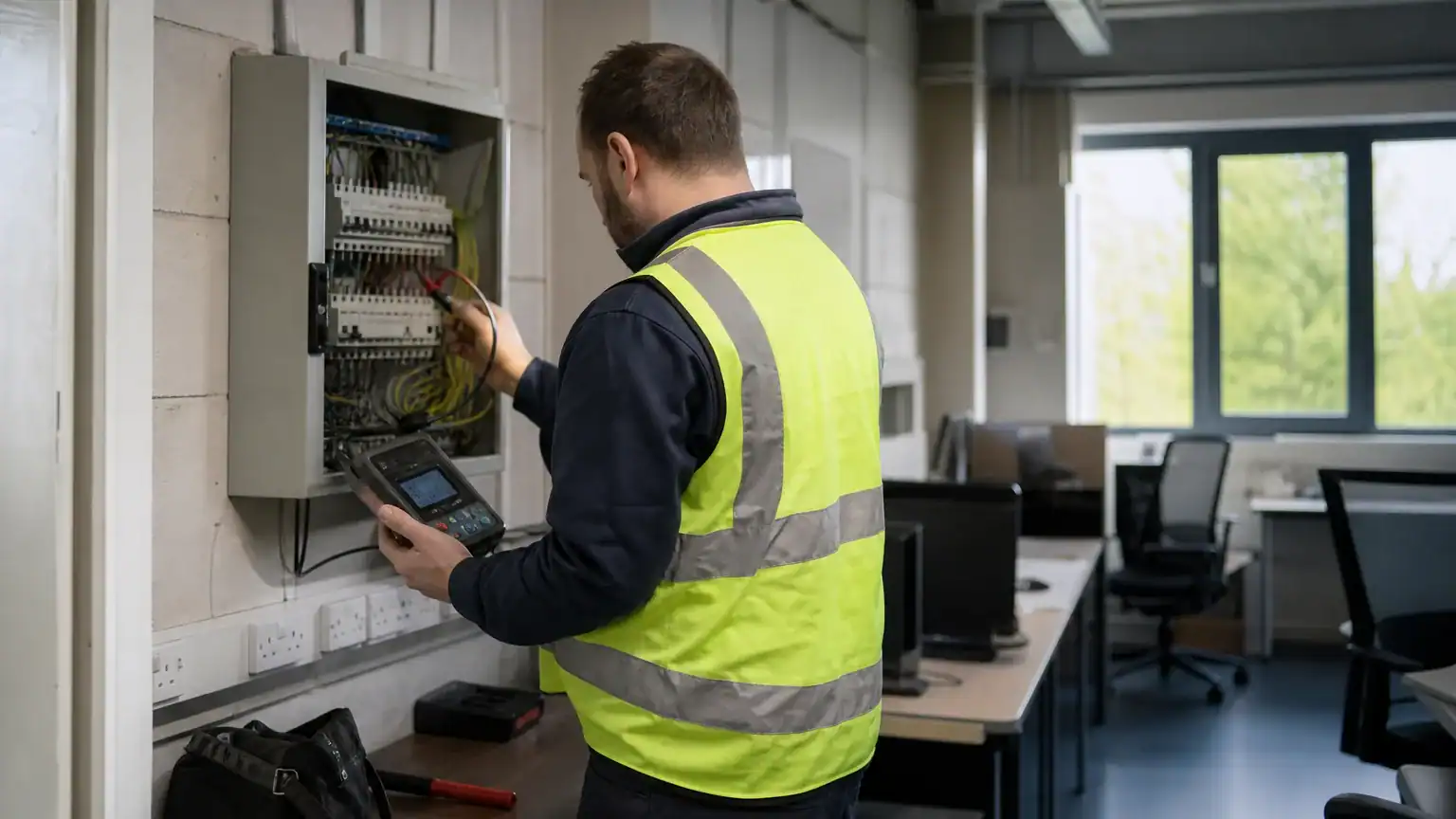
An inspector inspects and tests the installation to judge whether it is safe to keep using, then issues a report on what they found. You may also hear it called "fixed wire testing" or "periodic inspection and testing".
The Institution of Engineering and Technology (IET) model report gives its purpose as "to confirm, as far as reasonably practicable, whether or not the electrical installation is in a satisfactory condition for continued service". It should point out any damage, wear or faults, and anything that could put people in danger.
At the end, the inspector gives an overall assessment of satisfactory or unsatisfactory, based on the classification codes given to the observations. Any C1 or C2 code means an unsatisfactory result, and our guide to EICR codes explained sets out what each code means.
No law names the EICR itself as a requirement for commercial premises.
The Health and Safety Executive (HSE) puts it this way: "The law simply requires an employer to ensure that their electrical equipment is maintained in order to prevent danger. It does not say how this should be done or how often." Government guidance written for the defence estate states: "Regular inspection of electrical equipment, based on a suitable and sufficient risk assessment, is an essential part of any preventive maintenance plan."
On a lease of a whole building that tends to point to you as the tenant. On a lease of part of a building, the landlord typically looks after its retained parts and shared plant and recovers the cost from tenants.
Under a commercial lease, the duty can sit with the landlord, the tenant's business or both, depending on who controls which parts of the building and its electrics.
Owning the building is not what counts: as an employer occupying the premises, you keep the maintenance duty for the electrical equipment in your space. The lease then shapes who looks after which part of the building, so its wording is the next place to look.
Get a free quote for your compliance testing
The repair clause and the service charge clause do most of the work. The Royal Institution of Chartered Surveyors (RICS) Code for Leasing Business Premises describes how repairs have traditionally been split.
| Lease type or clause | Who usually handles repairs |
|---|---|
| Lease of a whole building | The tenant has traditionally been responsible for repairing and maintaining the entire building |
| Lease of part of a building | The tenant usually repairs the internal non-structural parts of its own area, and sometimes windows and shopfronts |
| Service charge | The landlord recovers the cost of its retained parts, often including communal boilers, lifts and other plant and equipment serving the building |
Where the lease reserves a service charge, RICS says the landlord should set out what services and works it pays for, how your share is worked out and an estimate of the first year's cost. Check that list to see whether inspection of the shared electrical plant is included, so you know what you are paying for and what is left to you.
If an item is excluded from your repairing obligation, that does not automatically mean the landlord has to repair it. RICS warns that a defect neither side is bound to fix can end up never being fixed at all. For electrics, an unrectified defect is a safety risk as well as a lease problem.
If a defect would stop you using the premises in any sensible way, RICS suggests the tenant try to make the landlord responsible for putting it right within an agreed time.
The National Inspection Council for Electrical Installation Contracting (NICEIC) strongly recommends that business owners have an EICR done no less often than every five years, and five years is usually the standard interval for offices and shops with normal risk levels.
The defence estate guidance lists the factors the inspector takes into account when recommending the next interval:
Your last report recommends the next date, and our guide on how long an EICR lasts explains how to read it.
Our guide to EICR remedial works walks through what happens after a failed inspection.
Under most leases, a tenant needs the landlord's consent before making alterations, and electrical changes such as new circuits, lighting or distribution work fall within that. Landlords usually cannot refuse consent unreasonably, but have it confirmed in writing, use a competent electrician and get the work certified, so it causes no trouble when the lease ends.
When you compare quotes, ask for a realistic completion date rather than assuming the work happens overnight. Once the work is certified, keep the paperwork with the original EICR, because insurers, auditors and any future tenant may ask to see the full history, not just the latest satisfactory result.
Finding an old distribution board, a supply that is too small or a failed EICR before you sign gives you something to negotiate with, while finding it afterwards leaves you holding the problem. A survey of the electrics measured against the lease, done before completion, shows you the real condition of the installation and the likely cost of keeping or upgrading it. If you are taking an assignment of an existing lease, bear in mind the property may be in poorer condition than it was when the lease began.
An unsatisfactory report will list the C1 or C2 observations that led to the result. Look out for FI (further investigation) observations as well: they mark an apparent deficiency the inspection could not fully identify, which may turn out to be a C1 or C2.
At Volta Compliance, our engineers are registered with NICEIC, Safe Contractor and the Electrical Safety Register. Most of our work is done in normal hours, and we test out of hours when required. You can see your certificates and reports in our EasyCompli portal at easycompli.com, where a compliance dashboard keeps all your paperwork in one place.
Get a free quote for your compliance testing
The person who ordered the report should receive the original, and the inspector should keep a duplicate. The IET says the original should be kept in a safe place and made available to anyone inspecting or working on the installation in the future.
Not necessarily. Someone carrying out EICRs needs adequate education, training and experience. The IET notes that an inspection and testing qualification is a good place to start, but experience is also necessary.
Last reviewed 2 November 2026 by Sam Carr.

