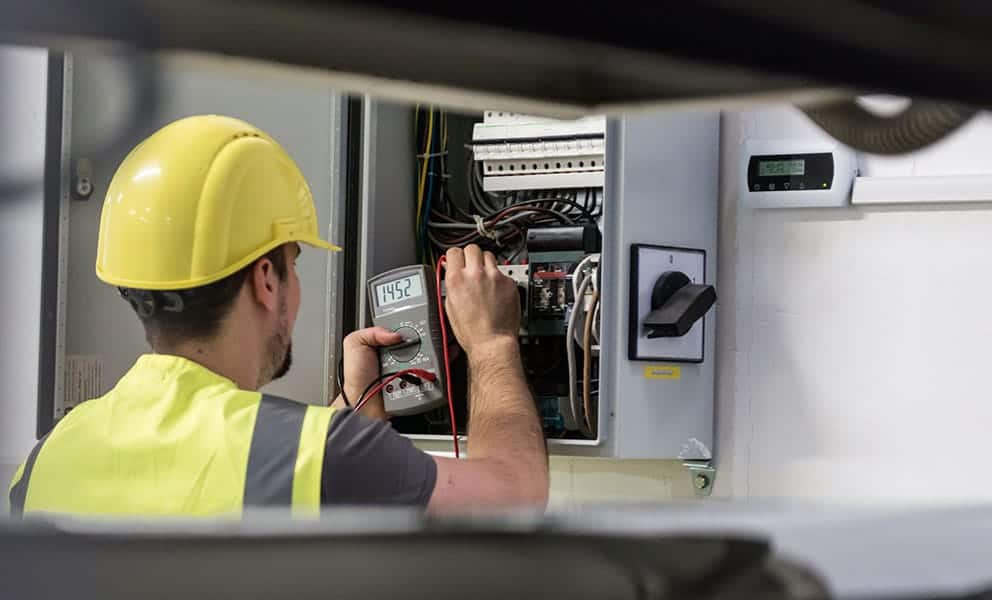
A qualified and competent contractor will check every aspect of your installation in line with the BS7671 standard and highlight any issues in their report.
Those issues will be categorised using the EICR codes c1, c2, c3 and FI. In this post, we’ll outline the meaning of C1, C2, C3 and FI to give you a better understanding of your EICR certificate.
Starting with the most serious code, EICR C1 indicates that danger is present on your electrical installation. The danger poses a risk of injury to anyone using the installation, meaning that immediate remedial action is required.
When a C1 fault is identified, the electrician will often take immediate action to make the installation safe, such as isolating the affected circuit. It’s recommended that you don’t use your electrical system until action has been taken. Failure to act on a C1 code could result in severe harm, electrical fires legal liability.
Taking one step down, EICR C2 means that something on your installation is potentially dangerous. While the issue may not yet pose a direct risk to your premises, staff or customers, it could become a hazard if left unattended.
As a result, C2 EICR codes require urgent remedial action. You may be able to continue using your system in the meantime, but you should arrange for repairs to be made as soon as you can. Like a C1 code, any issues categorised as C2 will mean the EICR is unsatisfactory until action is taken.
Unlike C1 and C2 codes, C3 faults do not indicate immediate or potential danger. Instead, they highlight areas where improvements could be made to enhance safety and compliance.
To be clear, in these examples no danger is present and there is no typical sequence of events that could lead to someone accessing live wires. As a result, EICR certificates can still be satisfactory when C3 issues are identified.
All that said, it’s best to have C3 issues rectified to improve the safety of your electrical installation and avoid more expensive issues developing over time.
The FI (Further Investigation) code is used when an electrician identifies a concern that requires deeper assessment, but doesn’t necessarily breach BS 7671 standards. Unlike the codes we’ve already mentioned, FI does not specify a direct level of danger – instead it signals that there’s not enough information available to make a full judgement.
FI issues must be investigated promptly. If they are severe or numerous, they may lead to an unsatisfactory EICR, requiring resolution before a pass can be given.
Once your EICR has been completed, you’ll receive a detailed report listing all findings, including any C1, C2, C3 or FI codes. But what should you do next?
A satisfactory EICR means no C1 or C2 faults were detected. However, if C3 recommendations were listed, you may still want to consider improvements to keep your system up to date and avoid costly problems in future.
If C1, C2 or multiple FI issues have been found, your EICR will be deemed unsatisfactory, meaning remedial action is required before you can be considered compliant.
Once all the faults have been addressed, you may need either a partial or full re-test to obtain a satisfactory EICR.
Many businesses only think about EICRs when a legal requirement or issue arises. However, the truth is that regular inspections have long-term benefits, including:
The Electricity at Work Regulations 1989 require businesses to maintain electrical systems in a safe condition. Regular EICRs help you prove compliance, and demonstrate your commitment to maintaining a safe work environment.
Most commercial insurance policies require proof of regular electrical inspections. Without an up-to-date EICR, claims may be invalidated if you suffer an electrical fault in your workplace.
A faulty electrical system can lead to power failures, costly downtime and even fire hazards. Proactive inspections help to catch issues early, reducing the risk of the worst ever happening to you.
Regular electrical checks are hugely important for preventing accidents and keeping your employees and customers safe. Faulty systems can cause electrical shocks, fire hazards and data loss.
By keeping up with EICRs, businesses reduce risks, protect assets and avoid costly emergency repairs.
At Volta Compliance, we aim to take the hassle and confusion out of EICR codes, their meaning, and the implications for your business. After a comprehensive EICR inspection, our experienced team will explain everything we find in plain English along with what you need to do to stay safe and compliant.
If you would like to arrange an EICR test for your Yorkshire business, don’t hesitate to contact us today on info@voltacompliance.com or 0113 436 0402.

